
Co-creation
A published algorithm earns citations.
A certified one can save lives.
You have a model that works on your own patients. We turn it into a certified application and put it in front of every hospital running the Intellicens Data Platform, with the revenue coming back to your institution.
↓
The issue
The bottleneck is not the science
2
%
of clinical AI models developed for the ICU reach the bedside. Of 1,263 studies, 25 progressed to clinical integration.
Berkhout et al., JAMA Netw Open 2025;8(7):e2522866
A model becomes a device the moment it informs care, and a device needs a quality management system, risk management, a technical file, a clinical evaluation, cybersecurity documentation, verification and validation across every software release, penetration testing, a notified body and post-market surveillance for as long as it is in use.
That is building a software company, not a research project. Hospitals are built to deliver care. We are built for the rest of it.

↓
What your institution gets
Capitalize the IP and clinical knowledge of your team, without building a software company
Your people stay on the clinical work
No software team to hire, no quality system to stand up, no notified body to court. Your researchers keep doing research while the engineering and the regulatory file are handled next to them.
Valorization without a spin-out
Ownership is agreed before development starts. The clinical insight stays with your institution and its inventors, and your teams keep publishing on the validation work throughout.
Revenue every time it deploys
A share of recurring revenue each time your tool is activated at another hospital on the network. Your own department is the first site to benefit from it.
↓
Become part of an eco-system
The standard for ICU AI is being set right now
In five years there will be a handful of platforms that clinical AI runs on, the way there are a handful of EMRs today. The units that put their models on those platforms early are the ones whose work becomes the default. The ones that wait will be licensing someone else's.
What ends up in this catalogue is decided by which centers show up first: which clinical questions get answered, which populations, which parameters. Once a question is covered, it is covered for the network.
NICU
In multicenter validation
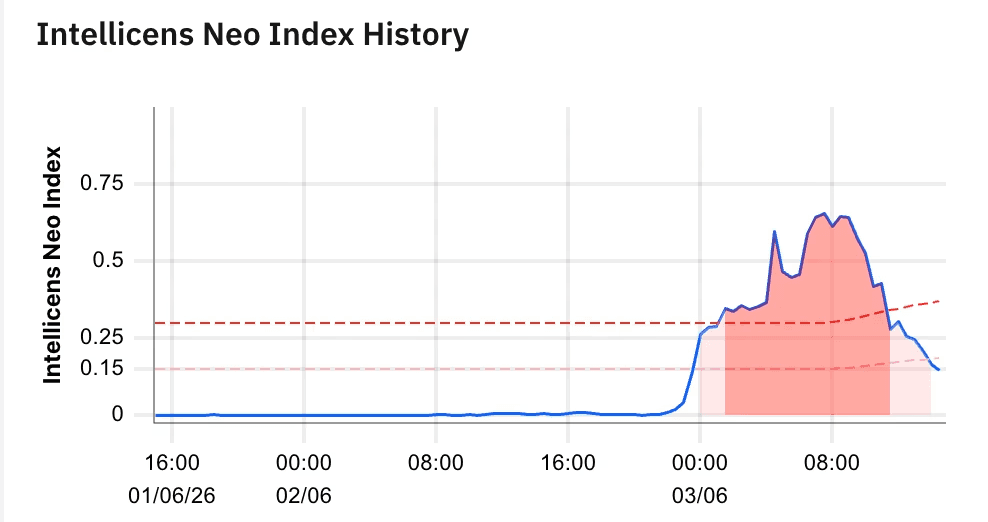
Intellicens Neo
Late-onset sepsis early warning, flagged a median 11 hours before clinical detection.
↳
Learn more
NICU
VALIDATED
You are a nosey bastard
You actually tried to read this. That is commitment. There is nothing here yet, but you clearly want to be the first to know when there is.
NICU
VALIDATED
Still nothing here
We could have filled this with a stock photo and the word innovation. You deserve better, so it stays empty until there is something real to put in it.
NICU
IN VALIDATION
This box is doing its best
It has a border, a rounded corner and absolutely no content. Somewhere a clinician is describing the thing that goes here, and that conversation is the actual product.
NICU
IN DEVELOPMENT
Reserved for someone's good idea
Possibly yours. The apps on this platform tend to start as a question from a unit that got tired of waiting for someone else to ask it.
PICU
In development
If you read this you owe David a beer
Belgian, cold, no negotiation. He is the one who keeps insisting that every algorithm has to explain itself before it goes anywhere near a bedside.
Adult ICU
In validation
We're going to build a spaceship
Not really. We are going to build the next decision support app. But the ambition is roughly the same, and the paperwork is arguably worse.
Your model
The next application in this catalogue has not been built yet. It may already be running in your unit.

↓
Your model, next in the marketplace
Your algorithm: certified, sold and deployed
With the Intellicens Data Platform, we provide the infrastructure to validate and deploy algorithms in every unit that needs them. We handle the data, the integration and the regulatory path, so your team keeps its focus at the bedside. And when your app runs in other hospitals, your institution shares in what it earns.

01
The platform was designed to take in external models. You give us a pre-processing container and a model container, we deploy them inside Intellicens and connect them to live monitor and EMR data.

02
Validate live in your own unit, then across our network, on real patients instead of a retrospective set. The platform labels your data automatically in the background, so the evidence builds itself.

03
Your model is built on documentation that already exists. If it fits the platform's intended use it joins the platform's file; otherwise it gets a file of its own on the same base. We add what is specific to it and carry it through the notified body.

04
Your model goes live in your own unit first, then across the network. Each hospital enables it as a subscription and runs it on their own servers. They pay for it, and the revenue comes back to you.
↓
Built for a catalogue
A regulatory file built for a catalogue, not a single device
Most medical device software is documented for exactly one product, so a second algorithm means a second dossier and years of the same work. Ours was structured from the start for many applications. The quality system, the platform architecture, cybersecurity, the software lifecycle and the post-market processes are documented once and shared.
A model that fits the platform's intended use is added to its file; one that goes further, like Intellicens Neo, gets a file of its own on the same base. Either way, your model adds only what is specific to it.
Done once, shared by every app
ISO 13485 quality system
Platform architecture and software lifecycle
Cybersecurity and data protection
Post-market processes
Notified body relationship with BSI, MD 817890
Routes defined under EU MDR 2017/745 and the FDA 510(k) pathway
Added per model
Clinical evaluation
Risk analysis
Verification and validation
For every model we take to market, we are the legal manufacturer for as long as it runs: post-market surveillance, vigilance, updates and every release after certification. Your institution never has to be.