
Company
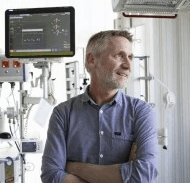
Founded at the bedside
Innocens was spun out of UZA and the University of Antwerp by clinicians who kept watching patient data stream past unread. We build the software that puts it to work.

↓
Why Innocens exists
From one incubator to every intensive care bed
The most vulnerable patients are the ones who cannot tell you what is wrong. A premature baby, a sedated adult, someone too sick to speak. They are also the most closely monitored people in the hospital, and the signs that they are deteriorating are usually already in that data hours before anyone acts on them. Our mission is to make those patterns visible, in every unit where the patient cannot speak for themselves.
Led by clinicians
Founder David Van Laere worked in the NICUs of Antwerp, Leuven and Sydney, and CMO Marisse Meeus is a neonatologist at Jeroen Bosch Hospital. It means every screen we build is reviewed by people who have had to read one on a night shift.
Built with the unit, not for it
Requirements come from the clinicians who will use it, not from a roadmap written somewhere else. Every model is validated on retrospective data from real intensive care units before it is switched on. And the people who have to act on a score decide how that score is shown to them.
We bring ideas to the bedside
Clinicians and researchers publish findings every year that could help patients in other hospitals. Almost none of them are entrepreneurs, so the work stays in the journal. We take it from there to a certified product at the bedside.
One question became infrastructure
We set out to answer one question in one neonatal unit: which babies were developing sepsis. Answering it properly meant building the data layer underneath it first, and that layer became the product. It runs on-premise inside the hospital and carries every application we add on top of it.
↓
Clinical and technology partners
Innocens is a spin-out of UZA in Antwerp, where founder David Van Laere spent fifteen years as a neonatologist. UZA remains our first clinical partner.

Our Partnership

Erasmus MC in Rotterdam is one of the academic NICUs where Intellicens Neo was externally validated, replicating its lead-time performance in a fully independent cohort.
Our Partnership


IBM Consulting and IBM Research helped Innocens build the early machine learning foundation for late-onset sepsis detection, using federated learning on IBM Watson Studio.

Our Partnership

Portainer runs the container infrastructure behind Intellicens, so modules and updates can be deployed on-premise at every hospital in the network without opening the perimeter.
Our Partnership

↓
Our vision for the future of critical care
Install the Intellicens Data Platform once. Add applications as the questions come.
Hospitals should not buy a new solution for every clinical question. They install the data layer once, then reach for whichever application answers the question in front of them. That changes how a hospital adopts algorithms: not as a procurement project per idea, but as a platform that is already in place when the next question arrives.
01
Install the Data Platform once
One on-premise platform per hospital, connected to the monitors and records already in use. No new hardware at the bedside, no patient data leaving the building.
02
Discover and trial new apps on your own data
A new application is released to the platform. A unit trials the candidate application for the new clinical problem against its own retrospective patients first.
03
Switch the app on when convinced
Only then is the application enabled in the unit, alongside the existing workflow. The layer stays in place; what runs on top of it grows with the questions the team asks next.

↓
Come work with us
Join the ride
We are a small team of clinicians, engineers and researchers just outside Antwerp. Whatever the role, you end up close to a real intensive care unit. If you want your work to reach a bedside, we should talk.
How we work
Small team, short cycles. We build with clinicians in the room, put it in front of a real unit, and let what happens there decide what comes next. Your work reaches people in weeks, not quarters.
Make an impact
A baby in an incubator cannot tell anyone that something is starting to go wrong. Our software gives their nurses hours of warning instead of minutes. That is what you would be working on.
Where we are heading
We started with one question in one unit in Antwerp. Next come adult and pediatric intensive care, hospitals across Europe and the United States, and a platform that other teams build their own applications on. You would join early enough to help decide how.
↳
Spontaneous application? Mail work@innocens.be