
In development
Intellicens Data Platform
The AI marketplace for intensive care
One platform that makes your continuous data usable, and a growing catalogue of clinical applications running on it. Developed with academic partners, deployed through a single installation.

↓
Why continuous data goes unused
There is more in your data than your monitors show
The modern ICU records more about every patient than any team can read. Monitors, pumps, labs and notes pour out thousands of values an hour, and the signals worth acting on get buried in the stream.
Then most of it is overwritten, and what survives never leaves the room. Ask a colleague what happened overnight and you get a memory. Ask your own researchers for last year's continuous data and it is gone.
~15,000
values per monitored bed per hour
96h
before most of it is overwritten [Matam & Duncan 2018]
0%
of it visible outside the room in many hospitals
↓
How we change that
A platform for the primary reuse of monitoring data
Primary reuse is putting the same data back to work for the patient it was recorded on, in the same admission.
Clinicians look at the real trend instead of a remembered one. Your unit gets the views and plots it actually needs, in the browser, without filing a request with a vendor. Your researchers work on the continuous record instead of reconstructing it by hand.
Why the Intellicens Data Platform is unique
01
Custom views on live primary data
Not a static data lake you query later. Data from the bedside monitors flows in continuously and stays available as one record per patient, so your teams can build interactive dashboards on it in the browser: the trends they want, side by side, for the whole admission.
02
One installation, many apps
Install once, connected to the monitors and records already in use across your NICU, PICU and adult ICU. After that, adding an application is a deployment instead of a procurement project. What runs on it is growing, and it is not all built by us.
03
We take your model to market
A model built in your unit cannot reach another hospital on its own. You validate it live on our platform, in your unit and across our network. If it holds up, we certify it, deploy it and take it to market as an application. Your institution keeps its stake and shares in what it earns.
Co-creation ↳
↓
What the Data Platform does
Built for how your unit actually works
Aggregates everything the unit already records, enriches it, and makes it re-usable. The platform reads continuously from the monitors and the EMR, on infrastructure the hospital already owns.
Electronic medical records
Records, notes, labs, workflow & PDMS data. Epic, Cerner, ChipSoft.
Connects via FHIR · XML
Monitoring solutions
Continuous bedside vital signs and visualization. Philips, Dräger, GE, Siemens and others.
Connects via HL7
Intellicens Data Platform · on-premise
One shared record of every patient. Across shifts, across rooms, across the full admission.

01
Connecting your existing devices
Intellicens reads the monitors at the bedside and pulls the matching context out of your EMR. It works with Philips, Dräger and GE over HL7 and FHIR, so each patient ends up with one continuous record instead of a screen that forgets. Nothing has to be replaced first.
02
Build the views your unit needs
The trends, plots and views that match your unit. Your team builds it, changes it, owns it. On call at 3am you look at the actual trend instead of asking someone to describe it, handover happens with the same data in front of both people, and a second opinion from another site takes a link, not a transfer.
03
Runs inside your own walls
Intellicens runs on your own servers or in your private cloud, behind the same firewall as the rest of your clinical systems. It connects over HL7 and FHIR to the monitors and EMR you run today. Access goes through your identity provider, so people sign in with the accounts they already have and see what their role allows.
04
Benchmark without the registry work
Unit performance metrics come straight out of the record you are already collecting. VON extracts for neonatal units, your own metric set for NICU, PICU and adult ICU, kept current as the data comes in rather than reconstructed once a year by hand.
05
Validate your own model
Run and refine a model against live primary data in your own unit, on the same pipeline the applications in the catalogue run on. Every step is documented for the regulatory file, so a model that proves itself has somewhere to go instead of stopping at a publication.
06
Annotation that happens by itself
The Data Platform proposes labels from patterns in the data. Clinicians confirm or correct them while reviewing patients, which is when they are looking at the trace anyway. Over a few months that produces a structured dataset large enough to train on, assembled out of routine review.
Intellicens Data Platform is investigational medical device software: not CE marked under EU MDR 2017/745, not cleared by the FDA, and not available for commercial clinical use.
↓
One install, then a switch
How an app reaches your unit
App library
Select the app you need
Search 10 apps
Intellicens Neo
VALIDATED
Developer
Innocens
Evidence
Multicenter, 1,100+ infants
Intended use
Late-onset sepsis early warning
Performance
<1 alert per patient/week
1 of 10
‹
›
Innocens cloud
One cloud push
A certified application is packaged and pushed from our side. No site visit, no engineer on a train.
Pre-processing
ML model
Your edge VM
Deployed as two containers
Edge VM, on premise
Pre-processing
ML model
Database, already installed
Your unit
Activated as a subscription
A subscription change, not an IT project. It runs on the data already flowing, and that data never leaves the hospital.
↓
The marketplace
A catalogue of clinical AI for intensive care
Every intensive care unit will run clinical AI. The only question is whether it arrives as twenty separate procurement projects or as one platform that is already installed. The layer runs under every monitored bed, and the ecosystem starts in the NICU.
NICU
In multicenter validation
Intellicens Neo
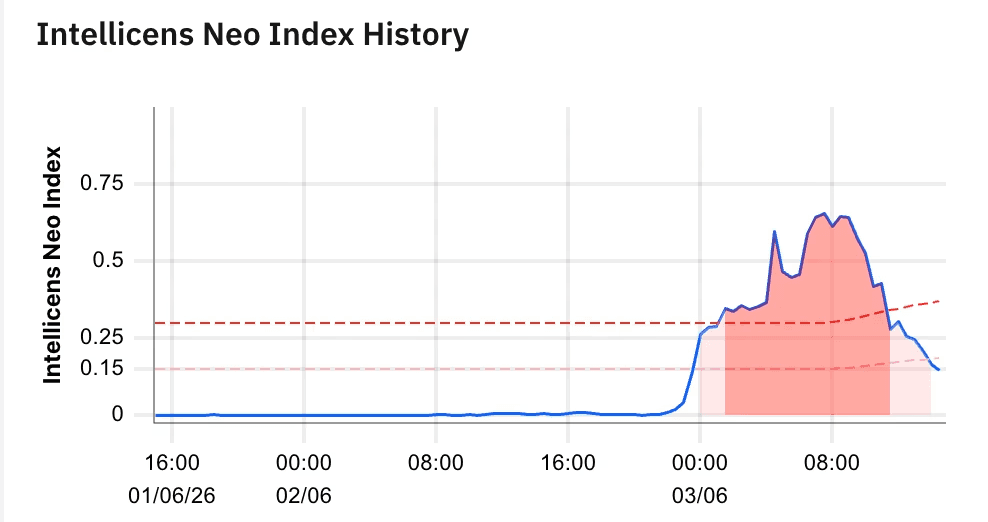
Late-onset sepsis early warning, flagged a median 11 hours before clinical detection.
↳
Learn more
Neo screenshot goes here
VALIDATED
You are a nosey bastard
You actually tried to read this. That is commitment. There is nothing here yet, but you clearly want to be the first to know when there is.
VALIDATED
Still nothing here
We could have filled this with a stock photo and the word innovation. You deserve better, so it stays empty until there is something real to put in it.
IN VALIDATION
This box is doing its best
It has a border, a rounded corner and absolutely no content. Somewhere a clinician is describing the thing that goes here, and that conversation is the actual product.
IN DEVELOPMENT
Reserved for someone's good idea
Possibly yours. The apps on this platform tend to start as a question from a unit that got tired of waiting for someone else to ask it.
PICU
In development
If you read this you owe David a beer
Belgian, cold, no negotiation. He is the one who keeps insisting that every algorithm has to explain itself before it goes anywhere near a bedside.
Adult ICU
In validation
We're going to build a spaceship
Not really. We are going to build the next decision support app. But the ambition is roughly the same, and the paperwork is arguably worse.
Any ICU
Your algorithm?
Work with us to market your own model and start earning revenue.
↳
Explore co-creation